Varivax™ : Proven Protection

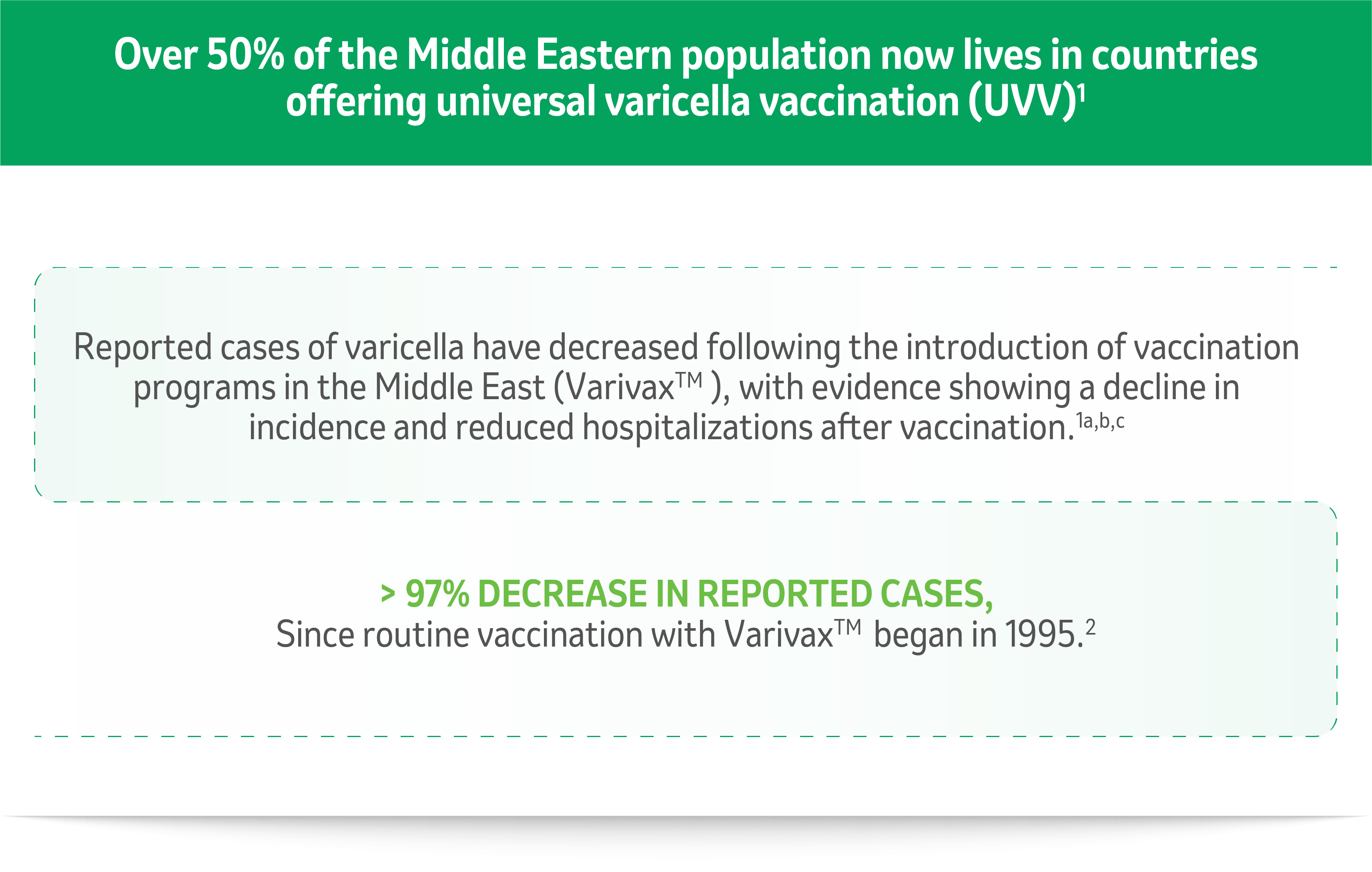
a the annual incidence rate of varicella in Abu Dhabi was 486 per 100,000 population in 2011. Following the introduction of government-funded universal varicella vaccination in 2012, there was a decrease in the rates of varicella that ranged between 147 and 168 per 100,000 population starting from 2013.
bOne study conducted in children (aged 2.0-15.5 y) in Turkey reported that the incidence of varicella was lower in vaccinated compared with unvaccinated children (4,550 per 100,000 patient-years vs 12,020 per 100,000 patient-years, respectively).
CA study from Saudi Arabia conducted prior to introduction of the UVV, indicated that approximately 2% of varicella cases required hospitalization.Only the VARICOMP study in Turkey provided population-level data on varicella hospitalization rates. The overall estimated annual incidence of varicella-related hospitalization per 100,000 children (aged 0-15 y) was 5.3-6.9 in Turkey in the pre-UVV era.Following the inclusion of varicella vaccine into the NIP in 2013, hospitalization in children aged 1-5 y fell significantly from 6.1 to 9.1 per 100,000 children per year (pre-UVV era) to 3.1-4.3 per 100,000 children per year (post-UVV era).
References
- Al Kaabi N, Al Olama FM, Al Qaseer M. The clinical and economic burden of varicella in the Middle East: a systematic literature review. Hum Vaccines Immunother. 2020; 16 (1): 21–32.
- Impact of U.s. chickenpox vaccination program. Chickenpox (Varicella).CDC. Accessed April 2026. https://www.cdc.gov/chickenpox/vaccination-impact/index.html
AE-VVX-00010 | Exp : 16 April 2028