

A multidisciplinary approach has the potential to improve cancer care1,2


A multidisciplinary team (MDT) supports collaborative decision-making between healthcare providers and patients across all phases of cancer treatment1,2,4,6

MDTs are tailored to each patient’s specific tumor type4,6-9
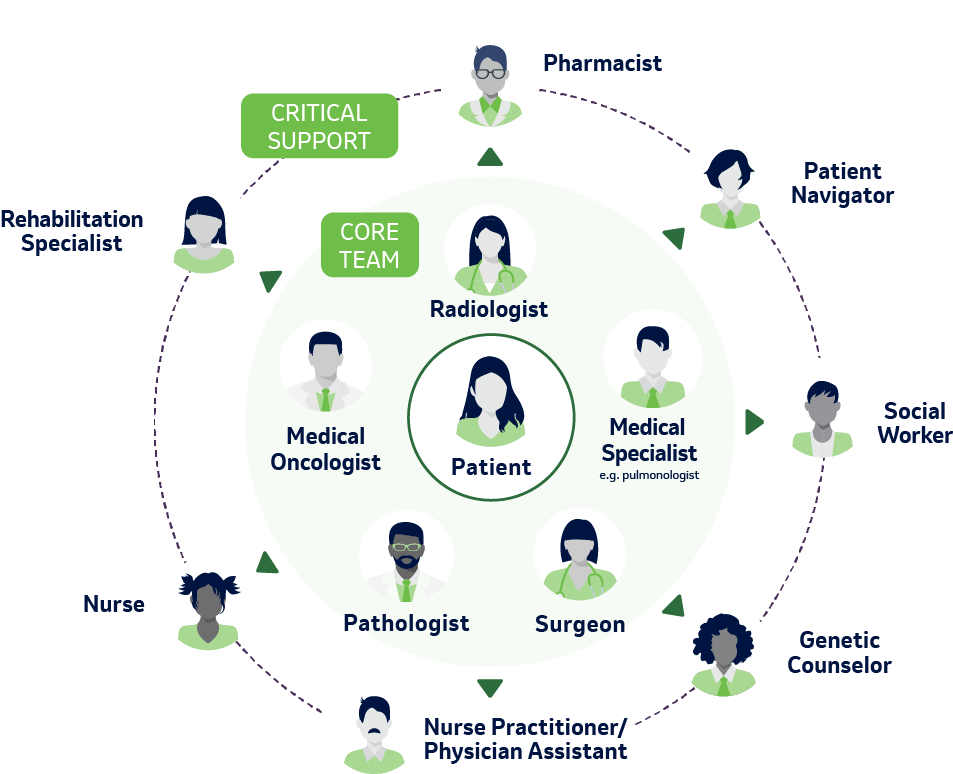

Guidelines recommend MDTs for comprehensive patient care10-13
National Comprehensive Cancer Network Clinical Practice Guidelines in Oncology (NCCN Guidelines®) and ESMO guidelines recommend an MDT approach to:10-13

Consider a multidisciplinary approach for your patients13
- Most early breast cancer cases can be cured by multimodality treatment, although cure rates vary by clinical stage and subtypes.13
- Patients with resectable NSCLC may benefit from an MDT approach.4,14
- MDTs can collaborate to identify patients eligible for neoadjuvant and adjuvant therapy.1,11,12
- Managing HNSCC is complex, requiring multimodal treatment and MDT collaboration to optimize care and patient adherence.15,16
A cross-speciality care model is KEY to advancing cancer care: Discover the potential benefits of an MDT4





ESMO: European Society for Medical Oncology; HNSCC: head and neck squamous cell carcinomaa; MDT: multidisciplinary team; NCCN: National Comprehensive Cancer Network; NSCLC: non small cell lung cancer.
KEYTRUDA® (Pembrolizumab) Selected Safety Information (SSI)
Selected indications: In combination with pemetrexed and platinum chemotherapy indicated for the first-line treatment of patients with metastatic non-squamous non-small cell lung cancer (NSCLC), with no EGFR or ALK genomic tumor aberrations. In combination with carboplatin and either paclitaxel or paclitaxel protein-bound indicated for the first-line treatment of patients with metastatic squamous NSCLC. Single-agent indicated for the first-line treatment of patients with NSCLC expressing PD-L1 [Tumor Proportion Score (TPS) ≥1%] as determined by a validated test, with no EGFR or ALK genomic tumor aberrations, and is either stage III where patients are not candidates for surgical resection or definitive chemoradiation, or metastatic. Single-agent indicated for the treatment of patients with metastatic NSCLC whose tumors express PD-L1 (TPS≥1%) as determined by a validated test, with disease progression on or after platinum-containing chemotherapy (patients with EGFR or ALK genomic tumor aberrations should have disease progression on FDA-approved therapy for these aberrations prior to receiving KEYTRUDA®). Single-agent indicated for adjuvant treatment following resection and platinum-based chemotherapy for adult patients with stage IB (T2a ≥4 cm), II, or IIIA NSCLC. Treatment of patients with resectable (tumors ≥4 cm or node-positive) NSCLC in combination with platinum-containing chemotherapy as neoadjuvant treatment and then continued as a single agent as adjuvant treatment after surgery.
In combination with platinum and fluorouracil (FU), is indicated for the first-line treatment of patients with metastatic or with unresectable, recurrent head and neck squamous cell carcinoma (HNSCC). As a single agent, is indicated for the first line treatment of patients with metastatic or with unresectable, recurrent HNSCC whose tumors express PD-L1 [Combined Positive Score (CPS) ≥1] as determined by a validated test. Treatment of patients with recurrent or metastatic head and neck squamous cell carcinoma (HNSCC) with disease progression on or after platinum-containing chemotherapy.
Treatment of patients with high-risk early-stage TNBC (triple-negative breast cancer) in combination with chemotherapy as neoadjuvant treatment, and then continued as a single agent as adjuvant treatment after surgery. In combination with chemotherapy, for the treatment of patients with locally recurrent unresectable or metastatic TNBC whose tumors express PD-L1 [Combined Positive Score (CPS) ≥10] as determined by a validated test.
Dosage & Administration: KEYTRUDA® is administered 30 minutes intravenous infusion.
Monotherapy: Adjuvant treatment of adult patients with NSCLC is 200 mg every 3 weeks or 400 mg every 6 weeks until disease recurrence or unacceptable toxicity, or up to 12 months. Adult patients with NSCLCs 200 mg every 3 weeks or 400 mg every 6 weeks until disease progression or unacceptable toxicity, or up to 24 months.
Adult patients with HNSCC is 200 mg every 3 weeks or 400 mg every 6 weeks, until disease progression or unacceptable toxicity, or up to 24 months.
Combination Therapy: Adult patients with NSCLC is 200 mg every 3 weeks or 400 mg every 6 weeks (administer KEYTRUDA® prior to chemotherapy when given on the same day), until disease progression or unacceptable toxicity, or up to 24 months. Adult patients with resectable NSCLC is 200 mg every 3 weeks or 400 mg every 6 weeks (administer KEYTRUDA® prior to chemotherapy when given on the same day), neoadjuvant treatment in combination with chemotherapy for 12 weeks or until disease progression that precludes definitive surgery or unacceptable toxicity, followed by adjuvant treatment with KEYTRUDA® as a single agent after surgery for 39 weeks or until disease recurrence or unacceptable toxicity.
Adult patients with HNSCC is 200 mg every 3 weeks or 400 mg every 6 weeks (administer KEYTRUDA® prior to chemotherapy when given on the same day), until disease progression or unacceptable toxicity, or up to 24 months.
Adult patients with locally recurrent unresectable or metastatic TNBC is 200 mg every 3 weeks or 400 mg every 6 weeks (administer KEYTRUDA® prior to chemotherapy when given on the same day), until disease progression or unacceptable toxicity, or up to 24 months.
Adult patients with high-risk early-stage TNBC is 200 mg every 3 weeks or 400 mg every 6 weeks (administer KEYTRUDA® prior to chemotherapy when given on the same day), neoadjuvant treatment in combination with chemotherapy for 24 weeks (8 doses of 200 mg every 3 weeks or 4 doses of 400 mg every 6 weeks) or until disease progression or unacceptable toxicity, followed by adjuvant treatment with KEYTRUDA® as a single agent for up to 27 weeks (9 doses of 200 mg every 3 weeks or 5 doses of 400 mg every 6 weeks) or until disease recurrence or unacceptable toxicity.
Contraindications: None
Precautions/Warnings: KEYTRUDA® can cause severe and fatal Immune-mediated Adverse Reactions which can occur in any organ, system or tissue as Immune-mediated Pneumonitis, Immune-mediated Colitis, Hepatotoxicity and Immune-mediated Hepatitis, Immune-mediated Nephritis with Renal Dysfunction, Immune-mediated Endocrinopathies (as adrenal insufficiency, hypophysitis, hyperthyroidism, hypothyroidism, thyroiditis & type 1 diabetes mellitus) & Immune-Mediated Dermatologic Adverse Reactions. KEYTRUDA® can cause other immune-mediated adverse reactions as: Myocarditis, pericarditis, vasculitis, Meningitis, encephalitis, myelitis and demyelination, myasthenic syndrome/myasthenia gravis (including exacerbation), Guillain-Barré syndrome, nerve paresis, autoimmune neuropathy, Pancreatitis, to include increases in serum amylase and lipase levels, gastritis, duodenitis, Hypoparathyroidism, Myositis/polymyositis, rhabdomyolysis (and associated sequelae, including renal failure), arthritis (1.5%), polymyalgia rheumatica, Hemolytic anemia, aplastic anemia, hemophagocytic lymphohistiocytosis, systemic inflammatory response syndrome, histiocytic necrotizing lymphadenitis (Kikuchi lymphadenitis), sarcoidosis, immune thrombocytopenic purpura, solid organ transplant rejection, other transplant (including corneal graft) rejection, Uveitis, iritis and other ocular inflammatory toxicities can occur. Some cases can be associated with retinal detachment. Various grades of visual impairment, including blindness, can occur. If uveitis occurs in combination with other immune-mediated adverse reactions, consider a Vogt-Koyanagi-Harada-like syndrome, as this may require treatment with systemic steroids to reduce the risk of permanent vision loss. KEYTRUDA® can cause severe or life-threatening infusion-related reactions, including hypersensitivity and anaphylaxis. KEYTRUDA® can cause complications of Allogeneic HSCT. Increased Mortality in Patients with Multiple Myeloma when KEYTRUDA® is added to a Thalidomide Analogue and Dexamethasone. KEYTRUDA® can cause fetal harm when administered to a pregnant woman.
Adverse Reactions:
Most common adverse reactions (reported in ≥20% of patients) were:
- KEYTRUDA® as a single agent: fatigue, musculoskeletal pain, rash, diarrhea, pyrexia, cough, decreased appetite, pruritus, dyspnea, constipation, pain, abdominal pain, nausea, and hypothyroidism.
- KEYTRUDA® in combination with chemotherapy or chemoradiotherapy: fatigue/asthenia, nausea, constipation, diarrhea, decreased appetite, rash, vomiting, cough, dyspnea, pyrexia, alopecia, peripheral neuropathy, mucosal inflammation, stomatitis, headache, weight loss, abdominal pain, arthralgia, myalgia, insomnia, palmar-plantar erythrodysesthesia, urinary tract infection, and hypothyroidism.
Please refer to the full prescribing information of KEYTRUDA® for more information.


Go beyond survival
Give your patients with M/uR HNSCC the opportunity to maintain quality of life with KEYTRUDA® monotherapy or in combination with chemotherapy.

Extend survival for your patients
KEYTRUDA® combination therapy: your first-line choice for appropriate patients. Explore KEYNOTE-590 data and its impact on clinical outcomes.

Expert discussion: 6+ years of high risk eTNBC survival data
In an exclusive interview, Prof. Schmid reveals the significant survival outcomes from the 7th interim analysis of the KEYNOTE-522 study.
References:
1. Cain H, Macpherson IR, Beresford M, et al. Neoadjuvant therapy in early breast cancer: Treatment considerations and common debates in practice. Clin Oncol (R Coll Radiol). 2017;29(10):642-52. 2. Shao J, Rodrigues M, Corter AL, et al. Multidisciplinary care of breast cancer patients: a scoping review of multidisciplinary styles, processes, and outcomes. Curr Oncol. 2019;26(3):e385-e97. 3. Harshman LC, Tripathi A, Kaag M, et al. Contemporary patterns of multidisciplinary care in patients with muscle-invasive bladder cancer. Clin Genitourin Cancer. 2018;16(3):213-8. 4. Hardavella G, Frille A, Theochari C, et al. Multidisciplinary care models for patients with lung cancer. Breathe (Sheff). 2020;16(4):200076. 5. Charara RN, Kreidieh FY, Farhat RA, et al. Practice and impact of multidisciplinary tumor boards on patient management: A prospective study. J Glob Oncol. 2017;3(3):242-9. 6. Association of Community Cancer Centers. Optimal care coordination model for lung cancer patients on Medicaid: environmental scan. 2016. Available at: accc-cancer.org/docs/projects/pdf/accc-care-coord-environmentalscan-final.pdf. Accessed 5 June, 2025. 7. Berardi R, Morgese F, Rinaldi S, et al. Benefits and limitations of a multidisciplinary approach in cancer patient management. Cancer Manag Res. 2020;12:9363-74. 8. Taplin SH, Weaver S, Chollette V, et al. Teams and teamwork during a cancer diagnosis: interdependency within and between teams. J Oncol Pract. 2015;11(3):231-8. 9. Levit L, Balogh E, Nass S, Ganz PA, editors; Committee on improving the quality of cancer care: addressing the challenges of an aging population; Board on Health Care Services; Institute of Medicine. Delivering high-quality cancer care: charting a new course for a system in crisis. Washington (DC): National Academies Press (US); 2013. 10. Referenced with permission from the NCCN Clinical Practice Guidelines in Oncology (NCCN® Guidelines) for Head and Neck Cancers. Version 2.2025. National Comprehensive Cancer Network, Inc. 2024. All rights reserved. To view the most recent and complete version of the guideline, go online to NCCN.org. Accessed June 5, 2025. 11. Referenced with permission from the NCCN Clinical Practice Guidelines in Oncology (NCCN® Guidelines) for Breast Cancer V.4.2025. © National Comprehensive Cancer Network, Inc. 2025. All rights reserved. To view the most recent and complete version of the guideline, go online to NCCN.org. Accessed June 5, 2025. 12. Referenced with permission from the NCCN Clinical Practice Guidelines in Oncology (NCCN® Guidelines) for Non-Small Cell Lung Cancer. Version 3.2025. National Comprehensive Cancer Network, Inc. 2024. All rights reserved. To view the most recent and complete version of the guideline, go online to NCCN.org. Accessed June 5, 2025. 13. Loibl S, André F, Bachelot T, et al. Early breast cancer: ESMO Clinical Practice Guideline for diagnosis, treatment and follow-up. Ann Oncol. 2024;35(2):159-82. 14. Eberhardt WE, De Ruysscher D, Weder W, et al. 2nd ESMO Consensus Conference in Lung Cancer: locally advanced stage III non-small-cell lung cancer. Ann Oncol. 2015;26(8):1573-88. 15. Gatta G, Botta L, Sánchez MJ, et al. Prognoses and improvement for head and neck cancers diagnosed in Europe in early 2000s: The EUROCARE-5 population-based study. Eur J Cancer. 2015;51(15):2130-43. 16. Taberna M, Gil Moncayo F, Jané-Salas E, et al. The multidisciplinary team (MDT) approach and quality of care. Front Oncol. 2020;10:85.
AE-KEY-00959 I Expiry date: 09.06.2027