
ARE YOUR ADULT PATIENTS AT INCREASED RISK FOR INVASIVE PNEUMOCOCCAL DISEASE (IPD)?
Knowing your patients’ risk status may be the first step in helping to prevent IPD.
Study Design
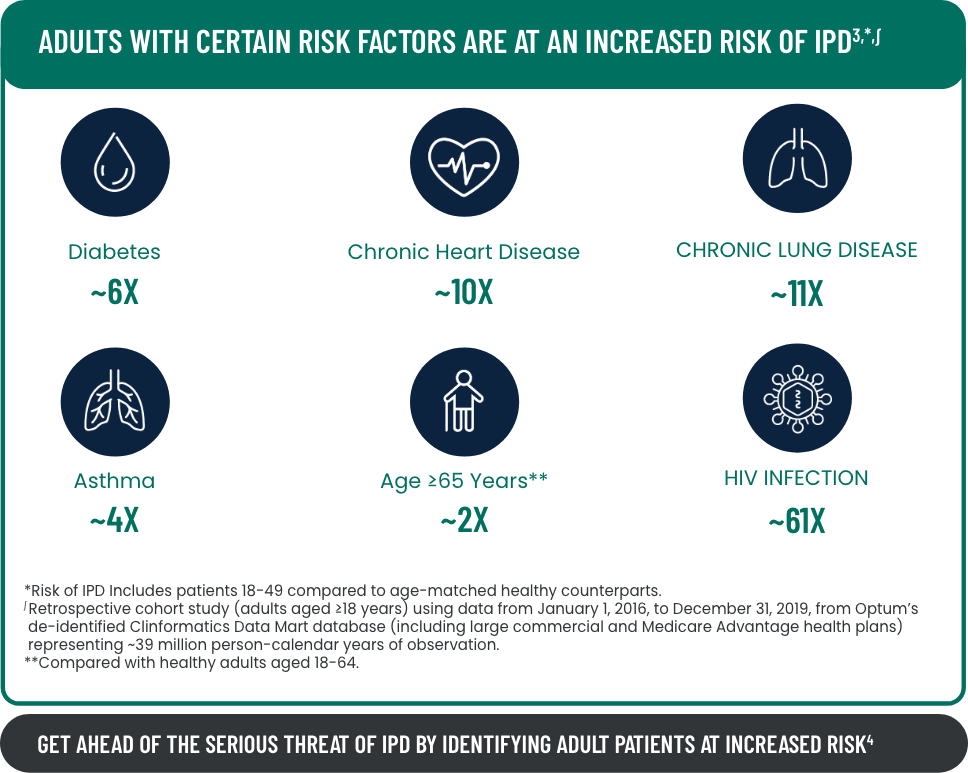
- A retrospective cohort study in US to determine the incidence of pneumococcal disease—all-cause pneumonia, IPD, and pneumococcal pneumonia—by age, risk profile, and individual medical condition among adults.3
- The study cohort was identified using de-identified claims data from Optum’s de-identified Clinformatics Data Mart Database (CDM) between January 1, 2016, and December 31, 2019. The study period was chosen to exclude the coronavirus disease 2019 (COVID-19) era and to include the time period immediately before PCV20 review/recommendation.3,b
- Patients ages were variable (18–49;n= 15.2 M) , (50–64; n=8.5 M), and (≥65 years n= 14.2M) person–calendar years of observation.3
Included Criteria
- Geographically diverse from all 50 states were included.3
- Patients were enrolled if they were: in a participating health plan on January 1st of each calendar year from 2016 to 2019 (index date), ≥18 years of age on the index date, and at least 1 year of continuous enrollment before the index date of each corresponding calendar year.3
- Patients were also included if they had episode of disease (all-cause pneumonia, invasive pneumococcal disease (IPD), pneumococcal pneumonia within a calendar year.3
- Observation period spanned January 1 to December 31 of each year, or until: Date of death, or date of disenrollment.3
- Patients meeting the criteria in multiple calendar years were included in the pooled analysis.3
Exclusion Criteria
- Patients with missing gender data.3
- Patients with a recorded death date before January 1 of the index year.3
- Patients with overlapping pneumonia inpatient admissions during the observation period.3
Outcomes Assessed
- Crude disease rates were calculated by episode care setting, within each age group and by risk profile, and among adults with a chronic medical condition (CMC) or an immunocompromising condition (IC), by number of medical conditions.3
- Within an age group and risk profile, disease rates of persons with select individual medical conditions were also calculated.3
- Disease rates were reported as the number of events per 100,000 person-years.3
- To maintain patient de-identification, disease rates were only presented when there were ≥10 episodes in that group.3
bCDM is a database of administrative health claims for members of large commercial and Medicare Advantage health plans.
References
- European Centre for Disease Prevention and Control. Surveillance Atlas of Infectious Diseases. Invasive pneumococcal disease. Accessed 26 September 2025. https://atlas.ecdc.europa.eu/public/index.aspx.
- Centers for Disease Control and Prevention. (2024). ABCs bact facts interactive data dashboard: SPN serotypes 1998–2023. Accessed 26 September 2025. https://www.cdc.gov/abcs/bact-facts/data-dashboard.html.
- Grant, L. R., Meche, A., McGrath, L., et al. (2023). Risk of Pneumococcal Disease in US Adults by Age and Risk Profile. Open forum infectious diseases, 10(5), ofad192.
- World Health Organization(WHO). Pneumococcal disease. Accessed on 26 September 2025. https://www.who.int/teams/health-product-policy-and-standards/standards-and-specifications/norms-and-standards/vaccine-standardization/pneumococcal-disease.
AE-NON-00601 | Expiry Date: 26/09/2027